Welcome to February and welcome to the first beta cycle of the year! It’s big, so let’s dive right in:
NVDA 2026.1 Beta TWO now available
Last week, we released Beta 1 of NVDA 2026.1 for download and testing. Before we could get In-Process out, we’re now at NVDA 2026.1 Beta 2! For anyone who is interested in trying out what the next version of NVDA has to offer before it is officially released, we welcome you to download the beta and provide feedback using our issue reporting process.
There are a LOT of highlights in 2026.1, let’s have a look, but if you have tried Beta 1 already and just want to know what changed in Beta 2, jump down to Beta 2.
Highlights
This release includes built-in support for reading math content with MathCAT.There have been several improvements to speech. Spelling errors can now be reported with a sound instead of speech when reading. You can now configure NVDA to automatically say all after successfully recognising content, such as with Windows OCR. NVDA no longer reports the language being read as unsupported when the synthesizer supports the language but not the specific dialect.
Braille support has also been improved. It now continues to work when switching to a secure screen, like the sign-in screen or User Account Control dialog. NVDA messages from the local computer are now shown in braille when controlling a computer via Remote Access. Spelling errors and the number of items in a list in browse mode can now be shown in braille. Other braille bug fixes, including in Microsoft Outlook and LibreOffice Writer, have also been added.
In browse mode in web browsers, NVDA no longer treats controls with 0 width or height as invisible. This may make it possible to access previously inaccessible “screen reader only” content on some websites. Malformed links no longer prevent NVDA from reading content in Google Chrome and other Chromium-based browsers. The browse mode highlighter now appears on content recognition results, such as when using Windows OCR. In Microsoft Word, unassigned Quick Navigation commands to jump to references have been added. They are also now shown in the elements list.
It is now possible to view virus scan results for an add-on from the Add-on Store. For add-ons that include one, you can also view an add-on’s changelog. The reliability of background add-on updates has been improved.
A new “Privacy and Security” category has been added to NVDA’s settings dialog. The “Logging level” and “Allow NV Access to gather NVDA usage statistics” settings have been moved here from the “General” category. The settings for Screen Curtain have also been moved here from the “Vision” category. Additionally, Screen Curtain’s settings are now configuration profile independent.
The NVDA interface is now translated to Cambodian. Liblouis, Unicode CLDR and eSpeak NG have been updated. Added tables for English Grade 3, Japanese (Rokuten Kanji), and Macedonian uncontracted braille. Improved the Biblical Hebrew, Unified English Braille, Greek International, Hungarian, Norwegian, Portuguese 8-dot and Slovakian braille tables. Emoji localizations for Luxembourgish have been added.
There have also been many other bug fixes and improvements.
There are also some things to be aware of, so let’s look at those as well:
Important Notes about NVDA 2026.1
- This release breaks compatibility with add-ons made for NVDA 2025.3.2 and earlier
- Windows 8.1 is no longer supported. Windows 10 is the minimum Windows version supported. We recommend updating to Windows 11, or when that’s not possible, to the latest Windows 10 version (22H2)
- 32-bit Windows is no longer supported. Windows 10 on ARM is also no longer supported
- Wiris MathPlayer is no longer supported
Changes introduced in Beta 2:
- Fixed an issue which prevented translated strings being used for the SAPI 4 and 32-bit SAPI 5 synth drivers
- Fixed a situation where NVDA may unexpectedly run as an administrator
- Improvements to the documentation about SAPI4 and 32-bit SAPI5 support
- Updates to translations
Download from the NVDA 2026.1 Beta 2 Release Announcement
Checking running programs at startup
If your system isn’t running as smoothly as you’d like, it might be worth checking what is starting up when you log into Windows. Since it’s a little more complex than might be ideal, here’s a walkthrough of the process as it works in Windows 11 (at least in version 25H2, Build: 26200.7705):
- Press the windows key to open the start menu
- Type “startup” as one word and ensure the focus is on “startup apps / system settings”, then press enter
- Use the down and up arrows to move through the list
- Press TAB five times until the focus is on the “list” and reads the name of an app or Microsoft service. Each item has properties which are not read by default
- Press NVDA+numpad 3 / NVDA+shift+] five times to move through the objects in flattened review – five times gets you to the impact (no impact through to high impact)
- Press NVDA+numpad 3 / NVDA+shift+] one more time to get to the “toggle button”. Not pressed means that item isn’t active. Pressed means the item IS set to run on startup
- Press tab once to get to that toggle button
- Press spacebar to toggle the item to either pressed (it will run on startup) or not pressed (it won’t run on startup)
- To get back to main list, press SHIFT+TAB, then back to step 3 in the first set of steps
If you’d like to change the state of an item:
Note that is how it works on my PC right now – a slightly different version of Windows might change the exact layout or number of times you need to press those keys, but that should give you a starting point to navigate those settings.
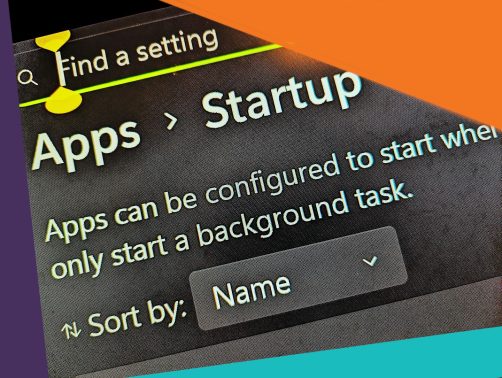
Screenshot of startup apps header with purple, orange and turquoise around edge.
NVDA 2026.1 and add-ons
As we do with the first release of each year, NVDA 2026.1 includes some changes to NVDA’s code. This helps keep NVDA secure, up to date and able to work with newer versions of dependencies we rely on. One big change this year is that NVDA is moving to 64-bit. This enabled us to update to a newer build of Python which is now 64-bit only, as well as other dependencies. We know this is frustrating for end users, however we do have a couple of exciting things to share about that:
- Firstly, Joseph Lee has been keeping an eye on add-on compatibility and noted that of 350 add-ons on the store, 46 need to be updated. That is only 13%! Joseph also included some tips for add-on authors working on the update for this year specifically.
- We are also working on a new secure add-on API which will enable add-ons to avoid having to update every year specifically for those compatibility-breaking changes in NVDA’s code.
We wrote a series of posts leading up to NVDA 2025.1 last year explaining in more detail why these changes are needed and how to minimise the impact, both for end users and add-on developers. Let’s recap them now:
- Our commitment to stability
- Add-on Compatibility Process
- Building for the future
- Best Practices for add-on developers
- What to Do if Your Add-on Breaks: A User’s Guide
- Recap: Stability and Compatibility – Our Top Priorities
That’s all for this week. We’ll have more on some of the specific exciting features of NVDA 2026.1 next time around. For now, do try out the 2026.1 beta, and be sure to give your feedback!